What a nonogram is
A nonogram is a logic puzzle on a grid of squares. Some squares belong to a hidden picture and must be filled; the others stay empty. You are not told which is which. Instead, every row and every column comes with a short list of numbers, and those numbers are all the information you need. Work through them line by line and the picture appears.
Playing nonograms on AllFun
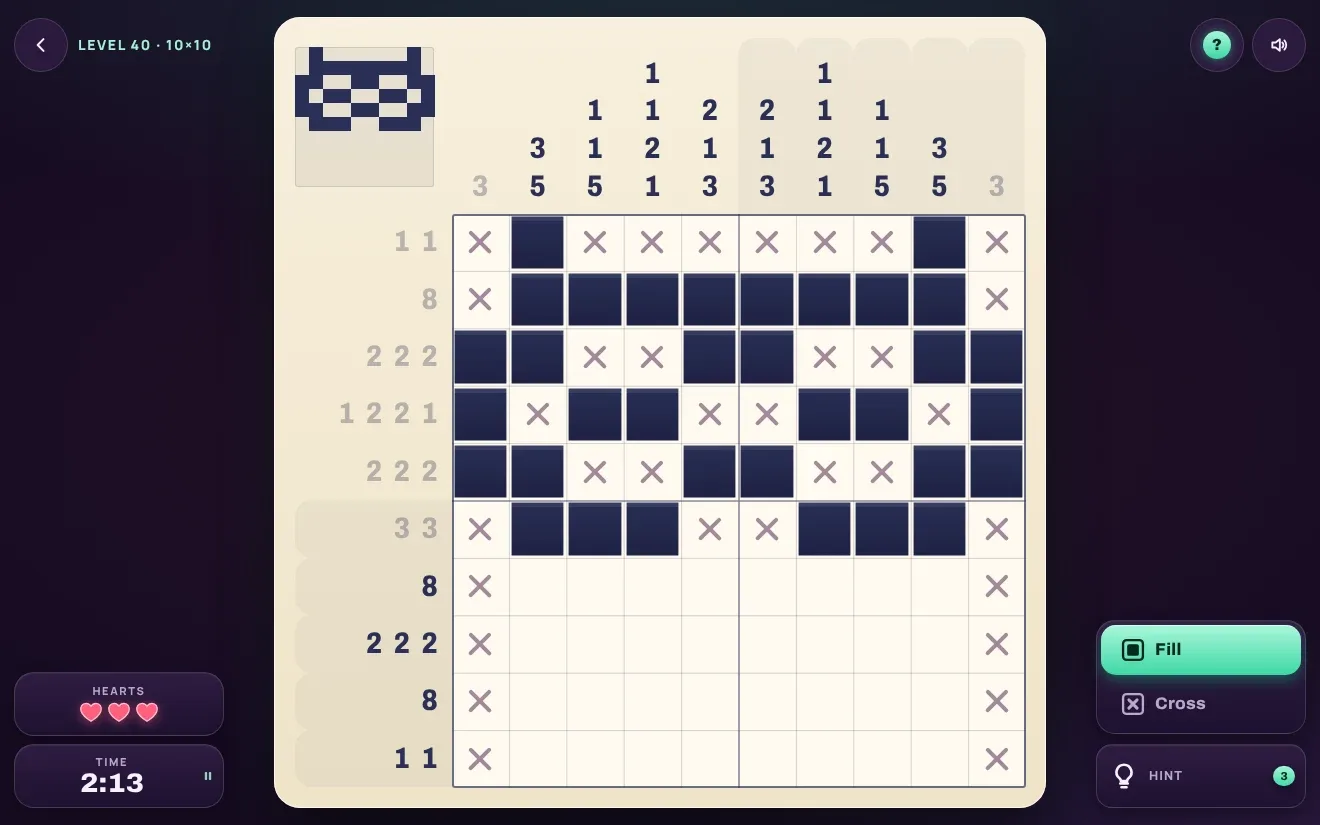
AllFun Nonogram has 81 pictures, from small 5×5 grids to large 15×15 ones, and a Daily mosaic that every player gets on the same day. Tap or drag to fill squares, switch to Cross to mark the empty ones, and watch the clue numbers turn grey as each line is completed.
A wrong square costs one of three hearts and is corrected for you, so a slip never ruins the puzzle. Pictures solved with no mistakes earn three stars. Hint fills a square that the clues already prove, which makes it a good teacher: try to see why that square had to be filled.
The rules
- Each number is a run of filled squares standing side by side, with no gap inside it.
- The numbers come in order: left to right for a row, top to bottom for a column.
- Two runs in one line always have at least one empty square between them.
- A row marked 0 has no filled squares at all.
- The puzzle is solved when every row and every column matches its numbers.
Solving step by step
1. Lines with only one answer
Add up the numbers in a line, plus one for each gap between runs. If the total equals the length of the line, there is just one way to place them. On a 5×5 grid, a 5 fills the whole row, and 1 1 1 can only go on squares one, three and five. Fill those lines first.
2. The overlap trick
Picture a long run pushed as far left as it can go, then as far right. Whatever squares it covers in both positions must be filled. A 7 in a row of 10 always covers squares four to seven, even before you know exactly where it starts. The same works with several numbers: slide them all to one side, then all to the other, and compare.
3. Cross what cannot be filled
Once a run is complete, mark the squares on either side of it with a cross. Squares that no run can reach are empty too. Crosses matter as much as filled squares, because they cut the space a run can move in.
4. Switch direction
Every square you fill or cross is also part of a column. After finishing a row, look down the columns it touched: often a new square there unlocks the next step. Solving is a back and forth between rows and columns until the picture is complete.
Tips for bigger puzzles
- Begin with the big numbers. Long runs give away the most squares through the overlap trick.
- Use the edges. A filled square touching the border pins the first run of that line to the edge.
- Count from both ends. The first number belongs near the start of the line and the last near the end.
- Revisit busy lines. When several new squares land in one line, read its clue again.
- Trust the grey numbers. A greyed clue means the line is done; skip it and save your attention.
A short history
Grid puzzles that hide a picture behind number clues were first published in the late 1980s and spread quickly through puzzle magazines and newspapers. Handheld games and phone apps later made them popular with a whole new generation of solvers.
Nonogram FAQ
Do nonograms need guessing?
Good ones do not, and none of ours do: each picture has been checked by a solver that only looks at one line at a time.
What does a 0 clue mean?
That the whole line stays empty, so you can cross every square in it right away.
Is a bigger grid always harder?
Mostly, because there are more lines to keep track of, but a 15×15 picture with long runs can be easier than a 10×10 full of ones.
Ready for a game? AllFun Nonogram is free and opens right here in your browser.
Play Nonogram