What Go is
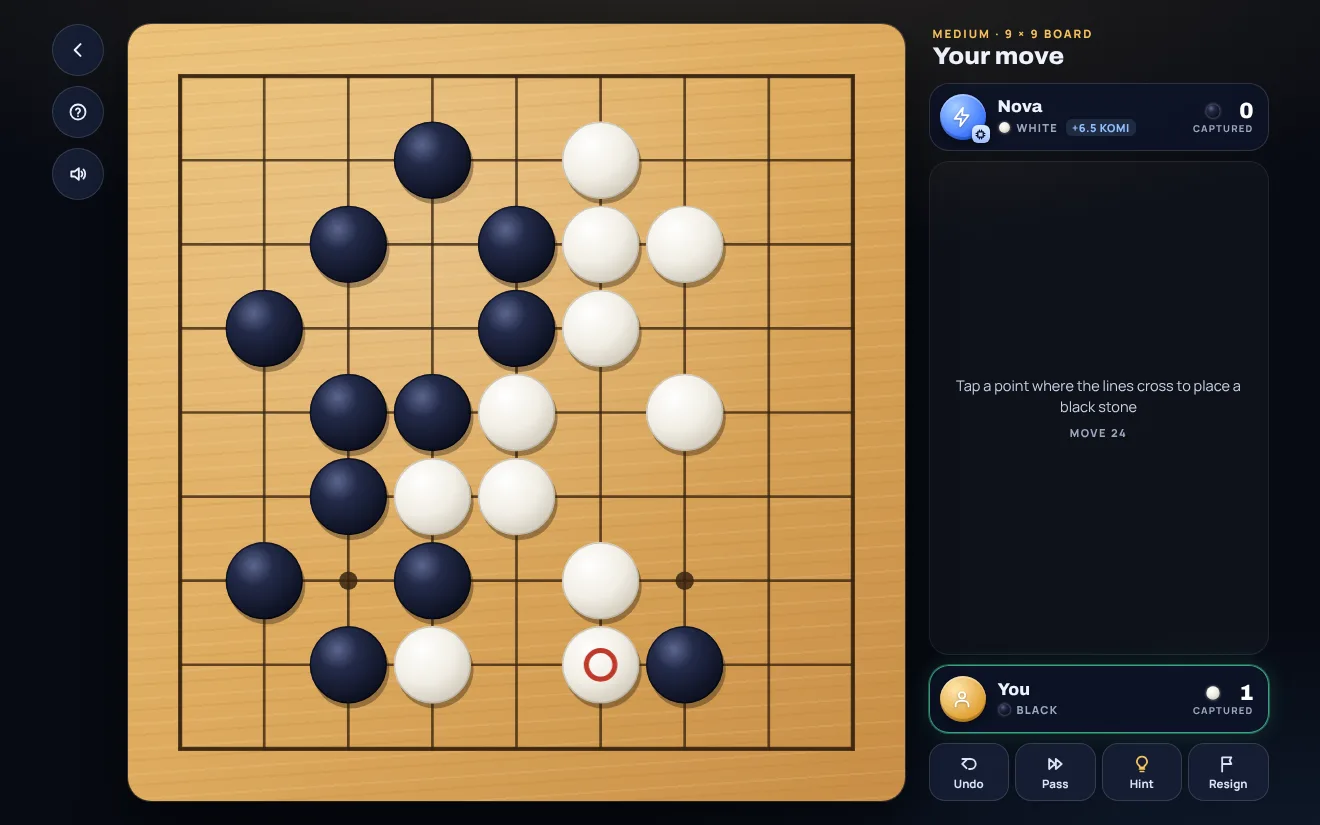
Go is a board game for two that has been played for thousands of years. One player has black stones, the other white, and they take turns placing a stone on an empty point of a grid. Stones never move, but they can be captured. The aim is to surround more of the board than your opponent, so every stone is both a wall and a claim to the land behind it.
The rules fit on one page, yet the game is deep enough that people study it all their lives. Small boards make it quick to learn: a 9 × 9 game takes a few minutes and teaches the same ideas as the full board.
Playing on AllFun
AllFun Go is played against Nova, a computer player, at Easy, Medium or Hard, on a 9 × 9 or a 13 × 13 wooden board. You play black and move first; white gets 6.5 points of komi for moving second. The light bulb shows a good move, Undo takes your last move back, and the count at the end marks the territory for you and lets you correct any group it got wrong.
The rules
- Placing: black starts, then the players take turns putting one stone on any empty point. You may also pass instead.
- Liberties: the empty points next to a stone, up, down, left or right, are its liberties. Stones of one colour that touch along the lines form a group and share their liberties.
- Capturing: when a move fills the last liberty of an enemy group, the whole group is removed from the board.
- No suicide: you may not play a stone that leaves your own group with no liberties, unless that move captures first.
- Ko: you may not take back a single stone at once if that would repeat the position before your opponent's move. Play elsewhere for a turn, and then you may.
- The end: when both players pass one after the other, the game stops. Stones that could not escape capture are marked dead and taken off.
- The count: each side gets a point for every stone it has on the board and every empty point it alone surrounds. White adds the komi, and the higher score wins.
Tips
- Corners first, then sides: a corner is walled in by the edges on two sides, so it takes the fewest stones to claim. The centre comes last.
- Two eyes live: a group with two separate empty points inside it can never be captured, because your opponent cannot fill both at once. When a group is in danger, make room for two eyes.
- Count the liberties: before you chase a group, compare its liberties with yours. A group with one liberty left can be taken on the next move: save it or let it go, but never by accident.
- Do not crawl along the edge: stones on the first line claim very little. Play on the third or fourth line early on.
- Pass when it is done: once the borders are closed, more stones inside your own area do not gain points. Pass and let the count decide.
Go FAQ
Can a game of Go end in a draw?
Not with a komi of 6.5: the half point always separates the scores.
What is the difference between Go and Gomoku?
Both use black and white stones on lines, but Gomoku is won by five in a row and nothing is captured. Go is about capturing and territory.
Which board size should I start with?
9 × 9. When you win there at Easy, try Medium, then the 13 × 13 board.
Why does the game say a group is dead?
At the end the count guesses which stones could not survive. If you disagree, tap the group to mark it alive before you accept.
Ready for a game? AllFun Go is free and opens right here in your browser.
Play Go