What Gomoku is
Gomoku is a strategy game for two played on a grid of lines with black and white stones. Players take turns placing one stone on an empty crossing, and the first to make an unbroken line of five, across, down or diagonally, wins. Stones are never moved and never captured, so every stone stays where it lands. It is also called Five in a Row or Gobang, and it is a grown-up cousin of tic-tac-toe: the same idea, but on a board big enough for real plans.
Playing Gomoku on AllFun
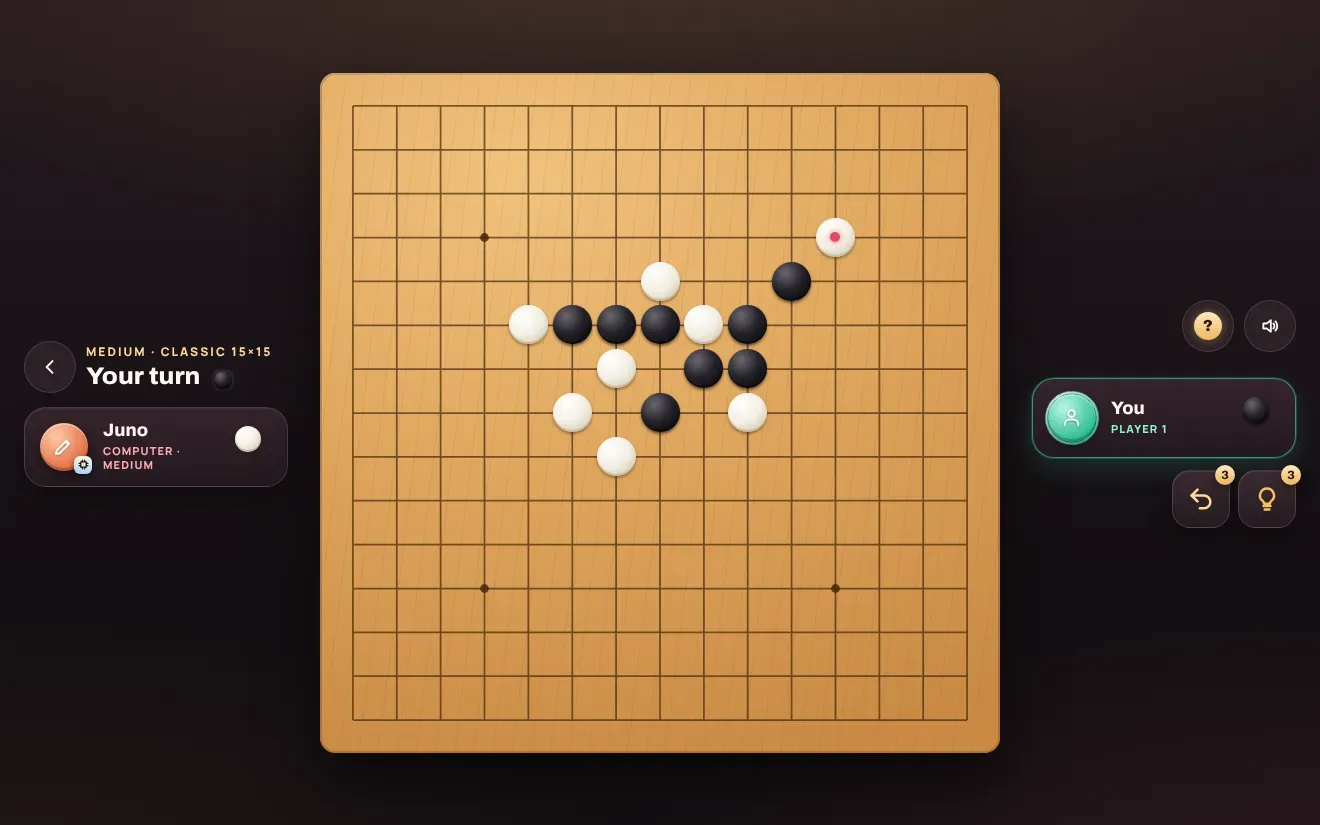
AllFun Gomoku offers the Classic 15×15 board and a Quick 11×11 board for a shorter game. You can face the computer at Easy, Medium, Hard or Master, pass one screen back and forth with 2 Players, or give each player their own device through Play Online and Play with a friend.
The last stone played carries a small red dot, so you always see the move you must answer, and a gold line marks the winning five. Against the computer you also get three hints and three undos in every game, at no cost.
The rules
Setting up
The board starts empty. The player who starts takes black and places the first stone anywhere; on AllFun the starting player changes from game to game.
Making a move
- Place one stone of your colour on any empty point where two lines cross.
- Once placed, a stone stays for the rest of the game.
- Players keep taking turns; there is no passing.
Winning and drawing
The first player with five or more of their stones in an unbroken straight line wins at once. If every point is filled and nobody has five, the game is a draw, which is rare on the full board.
Threes and fours
Almost all of Gomoku is about threats. A four is four stones in a line that can become five with one more move; it must be blocked at once. An open four has both ends empty, so it can be finished at either end, and no single block can stop it. An open three is three in a line with room at both ends: if it is not blocked, it becomes an open four on the next move. That is why an open three is already a serious threat.
Tips that win games
- Block open threes early. Put your stone at one end of an open three. Wait one move too long and it becomes an open four, and the game is over.
- Make two threats at once. A move that creates two open threes, or a four and an open three, cannot be answered with one stone. This double threat is how most games are won.
- Attack while you defend. When you must block, look for the blocking point that also extends one of your own lines.
- Keep the initiative. A four forces an answer. A chain of forcing moves lets you place stones where you want while the other player only reacts.
- Play near the action. Stones close to the other stones work harder than lonely stones at the edge, which have fewer ways to make five.
- Read the last move. Before you build, check what the other player's last stone threatens. Most lost games start with a missed three.
A short history
Five in a row has been played for centuries, often with the stones and board of Go, and it is known by many names. Because the first player has a strong advantage, a tournament form called Renju added limits on black's moves. In the 1990s computer research showed that on a 15×15 board, with perfect play, the first player can always force a win. That is one reason the start changes hands every game on AllFun.
Gomoku FAQ
Does a line of six count?
Yes. On AllFun any line of five or more wins, the open rules most people play.
Is going first an advantage?
Yes, black has the edge. That is why the first move alternates from game to game, so both players get the advantage in turn.
Which board should a beginner choose?
Quick 11×11 against Easy or Medium. The ideas are the same as on the full board, and games are shorter.
Can I play a friend online?
Yes. Choose Play with a friend, make an invite, then send your friend the link or read out the room code. Your friend plays in the browser, with no account needed.
Ready for a game? AllFun Gomoku is free and opens right here in your browser.
Play Gomoku