What Canasta is
Canasta is a card game of the rummy family, built around melds: sets of cards of the same rank laid face up on the table. Its special twist is the canasta, a meld grown to seven cards, which scores a large bonus. Wild cards, a discard pile that can be won whole, and a few special cards make every hand a mix of collecting and timing.
It is usually played by four in partnerships, but the two-handed game is just as popular, with a few rules changed so that each player holds more cards.
Playing Canasta on AllFun
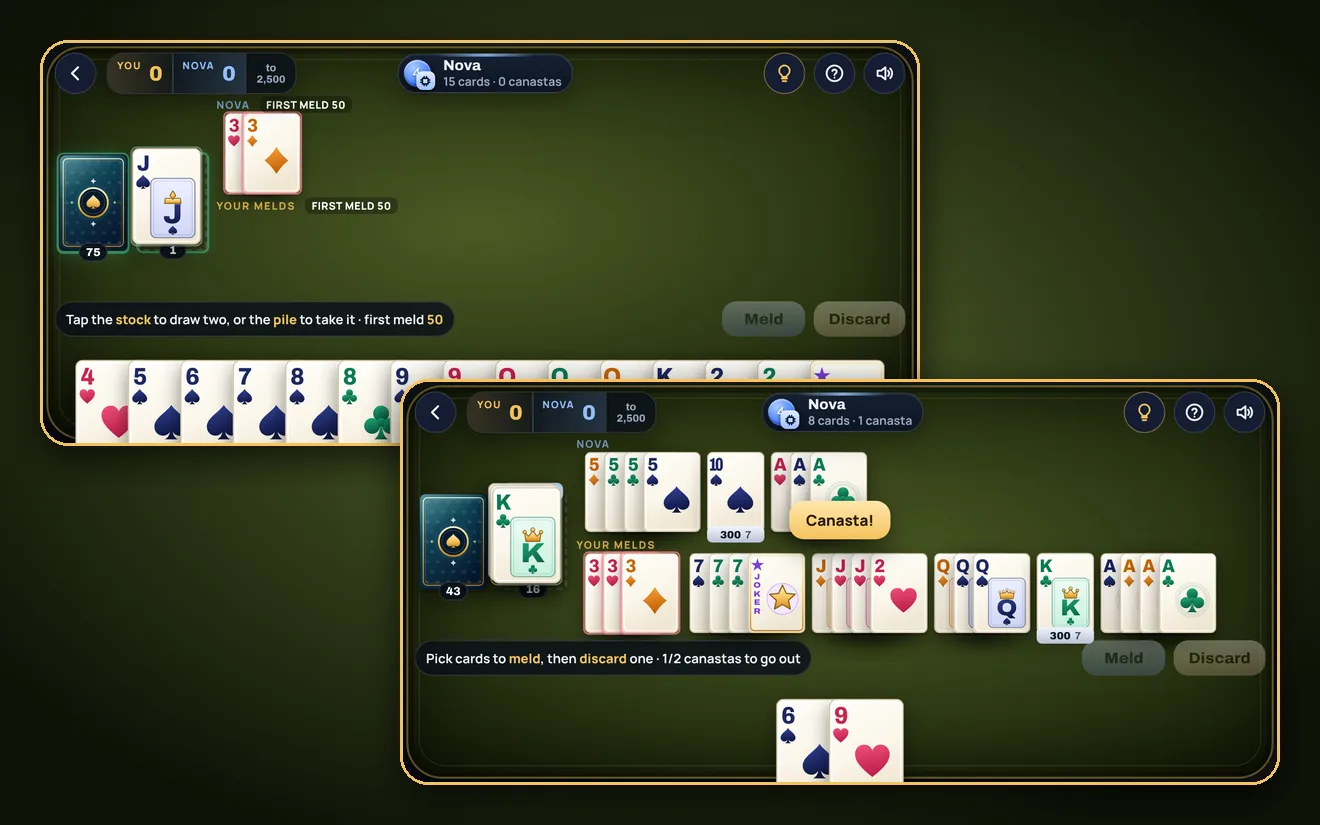
AllFun Canasta is the two-handed game, played against Nova, a computer player, at Easy, Medium or Hard, to 2,500 or 5,000 points. Your melds sit in a row above your hand and Nova's above yours; finished canastas are squared up with a ribbon. A line above your hand tells you what you can do next, and the light bulb suggests a move.
The rules
- The cards: two decks and four jokers. Jokers count 50 points, Aces and 2s 20, Kings down to 8s 10, and 7s down to 4s and black 3s 5.
- Wild cards: jokers and 2s can stand in for any rank in a meld. A meld needs at least two natural cards and may hold no more than three wild ones.
- The deal: fifteen cards each; the next card starts the discard pile.
- A turn: draw two cards from the stock, or take the whole discard pile; meld any cards you wish; then discard one card.
- The first meld of each hand must be worth at least 50 points in card values, rising to 90 once your score passes 1,500 and to 120 from 3,000.
- Taking the pile: the top card must go straight into a meld. Usually a natural card and a wild card of yours are enough, or a meld you already have. When the pile is frozen, because it holds a wild card or because you have not melded yet, you need a natural pair of the top card's rank.
- Threes: a red 3 is put face up at once and replaced, worth 100 (all four, 800). A black 3 on top of the pile stops the next player taking it, and black 3s can be melded only as you go out.
- Going out: you may go out, by melding or discarding your last card, only once you have two canastas.
Scoring a hand
Each side adds the values of the cards in its melds, 500 for each natural canasta and 300 for each mixed one, its red 3s, and 100 for going out (200 if the whole hand went down in one turn). The cards still in a hand are taken away. A side that never melded loses the value of its red 3s instead of gaining it.
Tips
- Build toward canastas. The bonuses are worth far more than the cards, so keep adding to a meld that is close to seven.
- Take a big pile when you can. More cards mean more melds, but remember they also count against you if the hand ends suddenly.
- Freeze the pile on purpose. Discarding a wild card makes the pile much harder for your opponent to take.
- Watch what your opponent melds. Avoid discarding ranks they hold, or they may take the whole pile.
- Use black 3s as safe discards when the pile is large.
Canasta FAQ
Why does the two-handed game draw two cards?
With only two players the stock would last a long time; drawing two keeps the game moving and the hands full of options.
Can a canasta hold wild cards?
Yes, up to three. It is then a mixed canasta, worth 300 instead of 500.
What happens when the stock runs out?
The hand ends when a player cannot draw and cannot take the pile; both sides score as usual, with no bonus for going out.
Is Canasta free on AllFun?
Yes, free in any browser, on a phone, tablet or computer.
Ready for a game? AllFun Canasta is free and opens right here in your browser.
Play Canasta