What bridge is
Bridge is a trick-taking game for four players in two fixed partnerships, with partners sitting opposite each other. What sets it apart from simpler trick games is the auction: before a card is played, the players bid against each other for the right to choose trumps, and the winning side commits to a number of tricks. The rest of the deal is spent trying to make that promise, or, for the other side, trying to stop it.
It rewards careful counting and good teamwork more than lucky cards, which is why so many people play it for a lifetime.
Playing bridge on AllFun
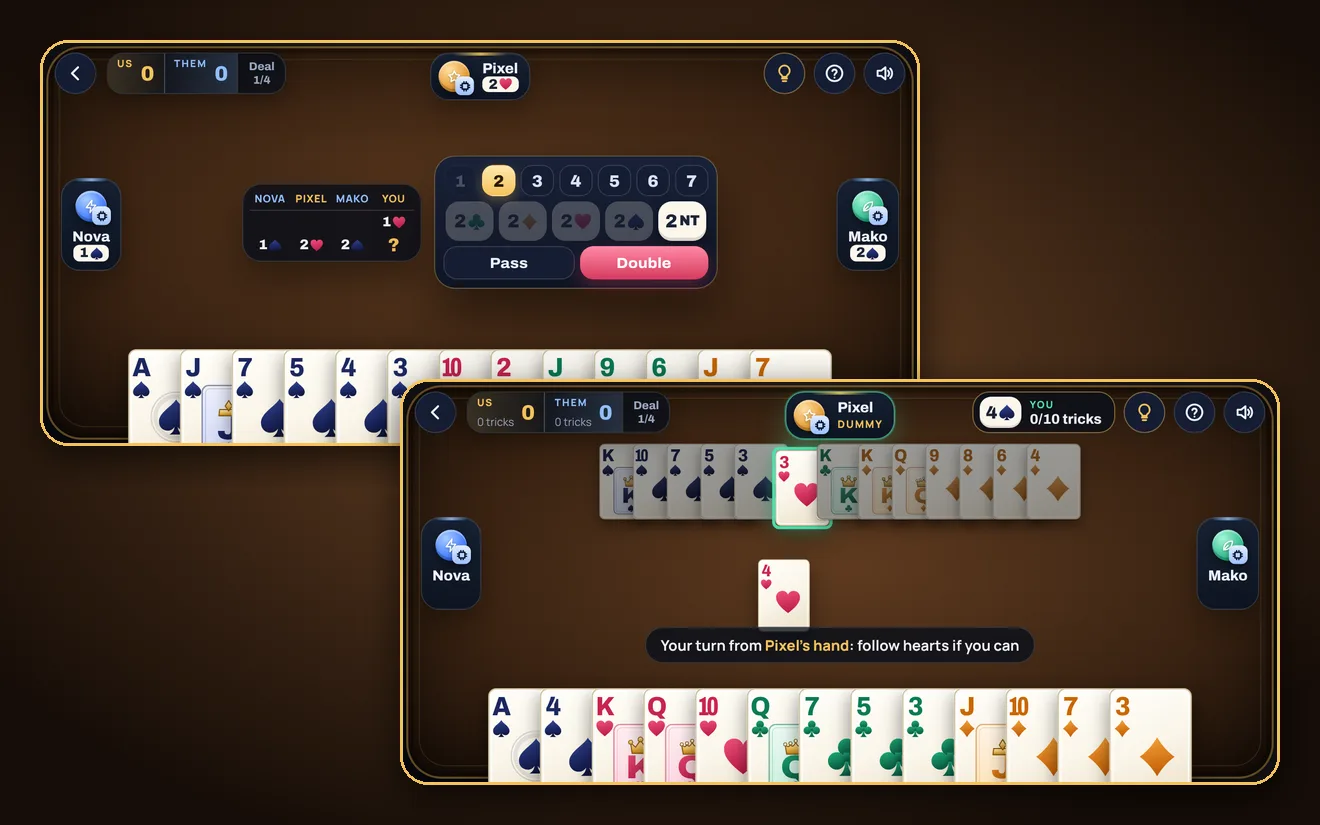
AllFun Bridge seats you at the bottom of the table with Pixel, a computer partner, across from you. Nova and Mako, two more computer players, are your opponents. A bidding box opens on your turn in the auction, a small table keeps the calls, and a chip at the top shows the contract and how many tricks have been won toward it. The light bulb suggests a call or a card whenever you want one.
The rules
- Valuing a hand: count high-card points, with Ace 4, King 3, Queen 2 and Jack 1. There are 40 in the deck, so an average hand holds 10. A long suit adds to a hand's strength when it becomes trumps.
- The auction: starting with the dealer, each player in turn makes a bid, passes, or doubles an opponent's bid. A bid is a level from 1 to 7 and a strain: clubs, diamonds, hearts, spades or no trumps, ranked in that order. Each bid must outrank the one before it.
- The level: add six to it to get the tricks you need. One heart promises seven tricks with hearts as trumps; three no trumps promises nine with no trump suit at all.
- The end of the auction: three passes after a bid end the bidding, and that bid is the contract. If all four players pass at the start, the cards are dealt again.
- Declarer and dummy: on the side that won the contract, the player who first named its strain is the declarer. The player on the declarer's left leads, then the declarer's partner, called the dummy, lays every card face up, and the declarer plays them too.
- The play: follow suit if you can; if not, play any card, a trump included. The highest trump wins the trick, or the highest card of the suit led.
Scoring
Each trick bid and made is worth 20 points in clubs or diamonds, 30 in hearts or spades, and in no trumps 40 for the first and 30 for the rest. A contract worth 100 or more of those points is a game and earns a bonus of 300, or 500 when your side is vulnerable; a smaller one earns 50. Six or seven of a level are slams, with bigger bonuses still. Going down gives the other side 50 or 100 points for each missing trick, and doubling raises the stakes in both directions. Over four deals the vulnerability rotates: nobody, then one side, then the other, then both.
Tips
- Open with about 12 points. With fewer, passing is usually right, unless you hold a long, strong suit.
- Look for a fit of eight cards. Eight trumps between you and your partner make a comfortable trump suit, most of all in hearts or spades.
- Add up the partnership's points. Around 25 between you is enough for a game in no trumps or a major suit, and around 33 for a small slam.
- As declarer, draw trumps early so the defenders cannot ruff your winners, then cash the tricks you can count.
- In defence, lead your partner's suit if they bid one; otherwise the top of a sequence such as King, Queen is a safe start.
Bridge FAQ
Is there a lot to learn before playing?
Less than its reputation suggests. Counting points, following suit and adding six to the level are enough to play a whole match, and the hint fills the gaps.
Who plays the cards when my partner wins the contract?
You do. On AllFun you always play both hands when your side declares, so you are never left watching.
What does vulnerable mean?
A vulnerable side wins bigger bonuses for games and slams but loses more for every trick it falls short.
Can I play bridge free?
Yes, in any browser on a phone, tablet or computer, with no download and no account.
Ready for a game? AllFun Bridge is free and opens right here in your browser.
Play Bridge