What snakes and ladders is
Snakes and ladders is a race across a numbered board. Each player has one pawn and moves it by the roll of a die. Ladders lift you towards the goal and snakes drag you back, so the lead can change on any roll. There are no choices to make, which is exactly why it suits small children: they practise counting and taking turns, and anyone can win.
Playing Snakes & Ladders on AllFun
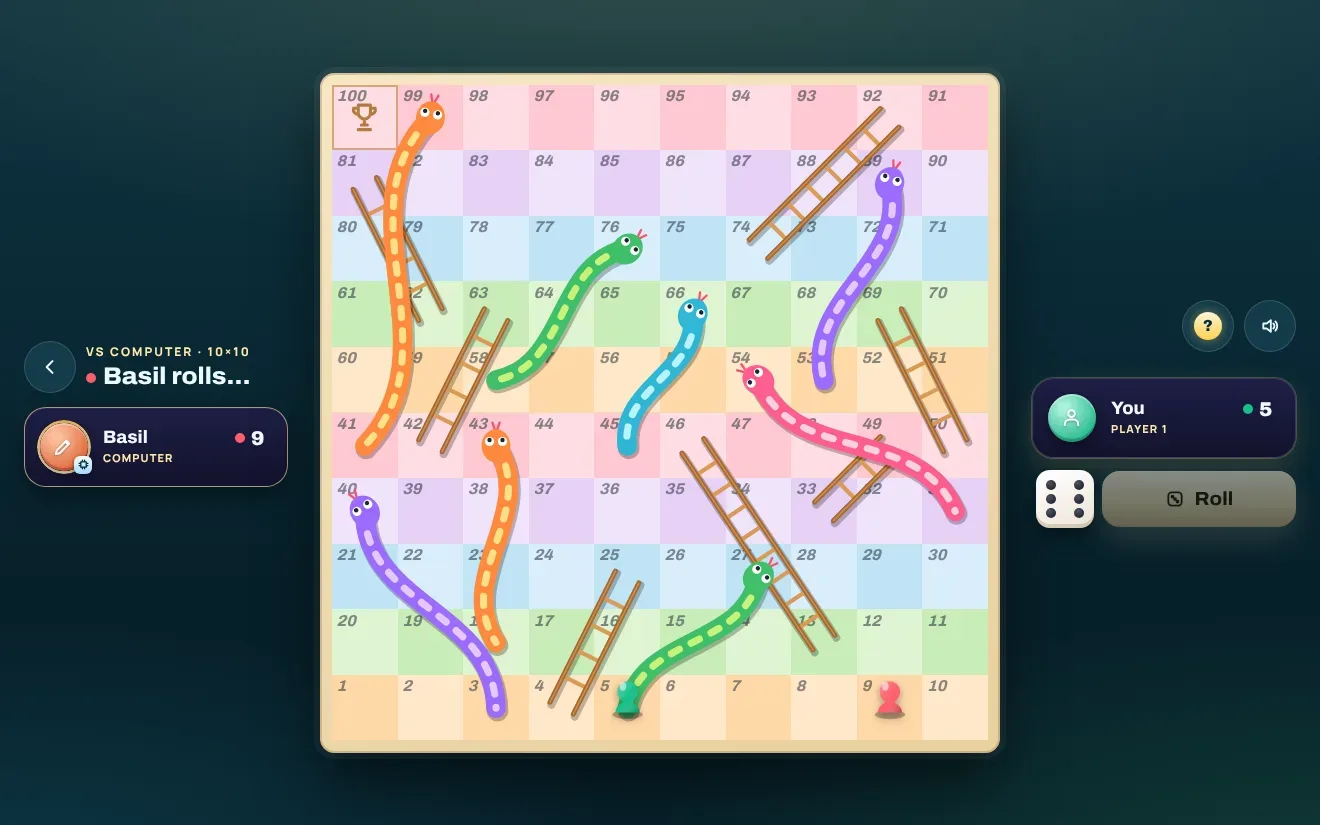
AllFun Snakes & Ladders draws the board in pastel rows with wooden ladders and striped snakes. Tap Roll and your pawn hops square by square, climbs or slides, and the next player goes. Choose the Classic 10×10 board with 100 squares, or the Quick 8×8 board with 64 for a shorter game.
Play the computer, pass one phone between two players, tap Play Online to meet another player, or send a friend a link with Play with a friend. Online, the die is rolled by our server, so neither player can pick a number.
The rules
The board
Squares are numbered from 1 in the bottom corner to the last square at the top. The numbers run along a row, then up one and back along the next, like a path folding back and forth. Every ladder joins a lower square to a higher one; every snake joins a higher square to a lower one.
Moving
Players start off the board and take turns to roll. You move forward as many squares as the die shows, counting the squares as you go. Two pawns can share a square; nothing happens to either.
Ladders and snakes
If your move ends at the foot of a ladder, climb straight to its top. If it ends on a snake's head, slide down to its tail. Passing over either does nothing: only the square you stop on counts.
Rolling a six
A six gives you another roll straight away. Some families add that three sixes in a row send you back to the start; AllFun keeps it simple and lets every six roll again.
The finish
You must land on the last square exactly. If your roll is bigger than the squares left, you move to the end and walk back by the rest, so a pawn three squares from home that rolls a five finishes two squares short.
Tips for a good game
- Count aloud with children. Hopping one square per pip makes the counting easy to follow.
- Pick the board by time. The Quick board takes a few minutes; the Classic one is better for a longer sit-down.
- Agree house rules first. Whether you need an exact finish, or a six to start, is best settled before the first roll.
- Enjoy the swings. A long ladder late in the game can turn a losing race around in one move.
A short history
The game is very old. Early boards were moral lessons: ladders stood for good deeds and snakes for bad ones, and the race up the board was a picture of a life's journey. Over time it lost the lessons and became the family dice game known around the world, printed on the back of countless board-game boxes.
Snakes and Ladders FAQ
Do you need a six to start in snakes and ladders?
Not in AllFun's version: your first roll moves you onto the board. Some families play that you need a six to start; it only makes the game longer.
Do you have to roll the exact number to finish?
Yes, in AllFun's version. A roll that goes past the last square bounces you back by the extra squares.
Is snakes and ladders all luck?
Yes. Every move is decided by the die, which is why a four-year-old can beat a grown-up fair and square.
How many ladders and snakes are on the board?
The Classic board has seven ladders and eight snakes; the Quick board has five ladders and six snakes.
Ready for a game? AllFun Snakes & Ladders is free and opens right here in your browser.
Play Snakes & Ladders