What Memory is
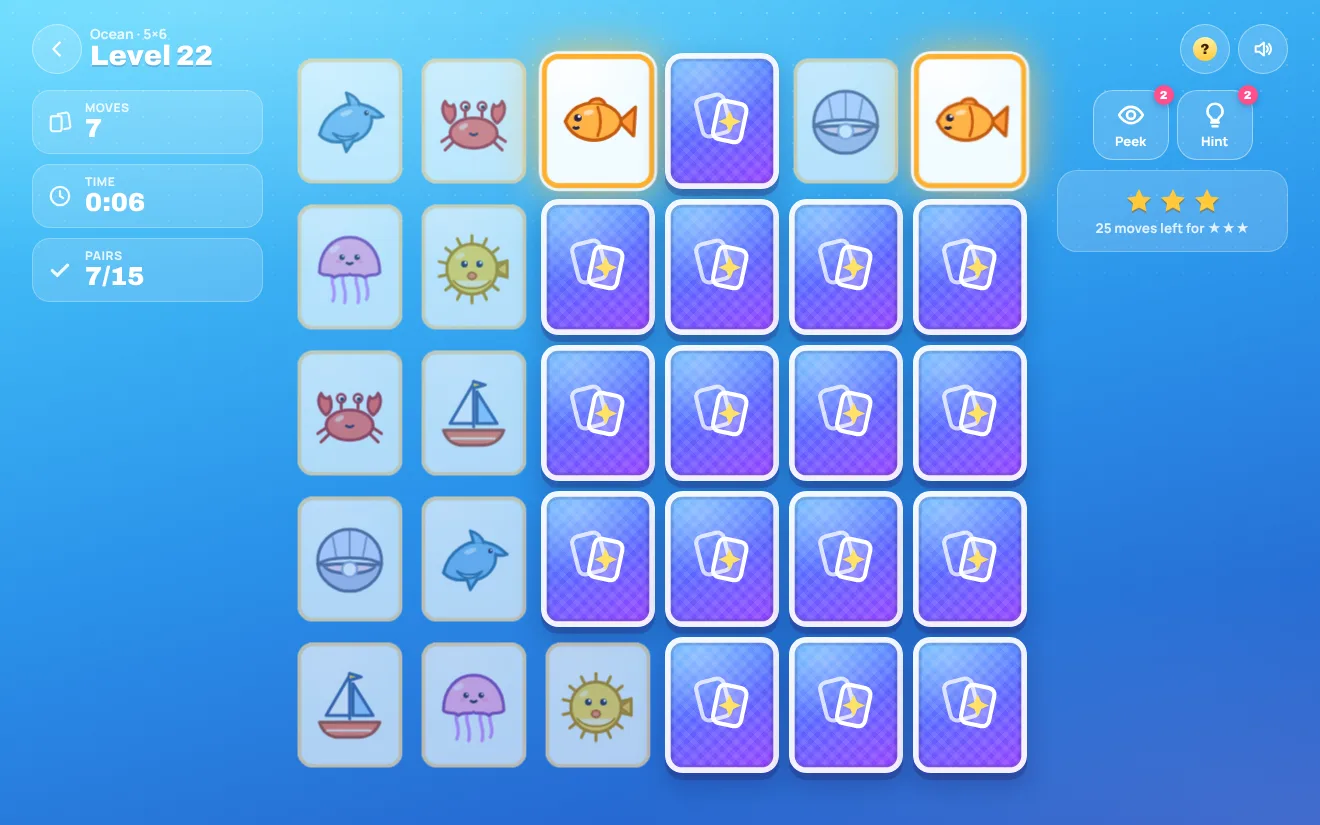
Memory, also known as Pairs, Concentration or Match up, is a game in which every card is laid face down in a grid and every picture appears twice. On each turn you turn over two cards. If they match, you keep the pair; if not, they go back face down. A child can learn it in a minute, yet a large board with a strong opponent is a real test for adults.
Playing Memory on AllFun
AllFun Memory has 72 levels in six decks of pictures drawn for the game: Garden, Ocean, Snacks, Pets, Travel and Space. Boards grow from six cards to 48. Later levels bring a Lucky star that shows every card for a moment, trios to match instead of pairs, cards that swap places after a run of misses, and boards that mix two decks. Peek and Pair hint are free once a level.
The Daily Memory is the same board for everyone, small on Monday and a 6×6 on Sunday. 2 Players and vs Computer use Small 4×4, Medium 4×6 or Large 6×6 boards; the computer players, Mako, Nova and Vega, remember only what has been shown and forget some of it, Mako most and Vega least.
The rules
Setting up
Shuffle the cards and lay them face down in rows. With an ordinary pack of playing cards, a pair is usually two cards of the same rank and colour.
A turn
- Turn over two cards, one after the other, so everyone can see them.
- If they match, take the pair and go again.
- If not, turn both face down in the same places, and the turn passes.
Winning
When the last pair is taken, the player with the most pairs wins; ties are possible on boards with an even number of pairs. Alone, you play against the count of moves, where a move is one turn of two cards. On AllFun, three stars on a board of pairs needs about two moves per pair plus two: eighteen moves for eight pairs.
Variations
Some house rules end the turn after a pair instead of giving another go. Trio boards ask for three of a kind, so each turn shows three cards. With playing cards, some accept any two cards of the same rank as a pair.
Six strategies that work
- Open a new card first. Begin each turn with a card you have never seen. If it matches one you remember, take the pair; if not, you learnt something.
- Then gamble on another new card. If the first card has no known partner, a second unseen card might match by luck and shows you one more picture.
- Against a person, give nothing away. When your first card is new and has no known partner, turning a card you already know second shows your opponent nothing new.
- Search in order. Work through the board row by row, so you remember cards by position in a sequence rather than scattered spots.
- Name and place. Say the picture and where it is, "fish, top left", or link neighbours into a little story.
- Watch the last few. Most mistakes are on cards seen once. Keep the unmatched ones fresh rather than the whole board.
Even a player who never forgets needs a little over one and a half moves per pair on average, because every card's first appearance is a guess.
A short history
Matching games with face-down cards have long been played with ordinary playing cards. Picture versions for children became popular in the twentieth century, and similar tasks are still used to study short-term memory.
Memory game FAQ
What is the best strategy for the memory game?
Turn an unseen card first, take any pair you know, and otherwise turn a second unseen card. Against an opponent, turn a known card second when you cannot make a pair.
How many cards are in a memory game?
Any even number of pairs works. AllFun boards go from six cards on the first level up to 48 on the largest.
Does the computer player cheat?
No. It knows only the cards that have been turned face up, and it forgets some of them, just as a person does.
What is a trio level?
A board where every picture appears three times. You turn three cards each move and need all three to match.
Ready for a game? AllFun Memory is free and opens right here in your browser.
Play Memory