What mancala is
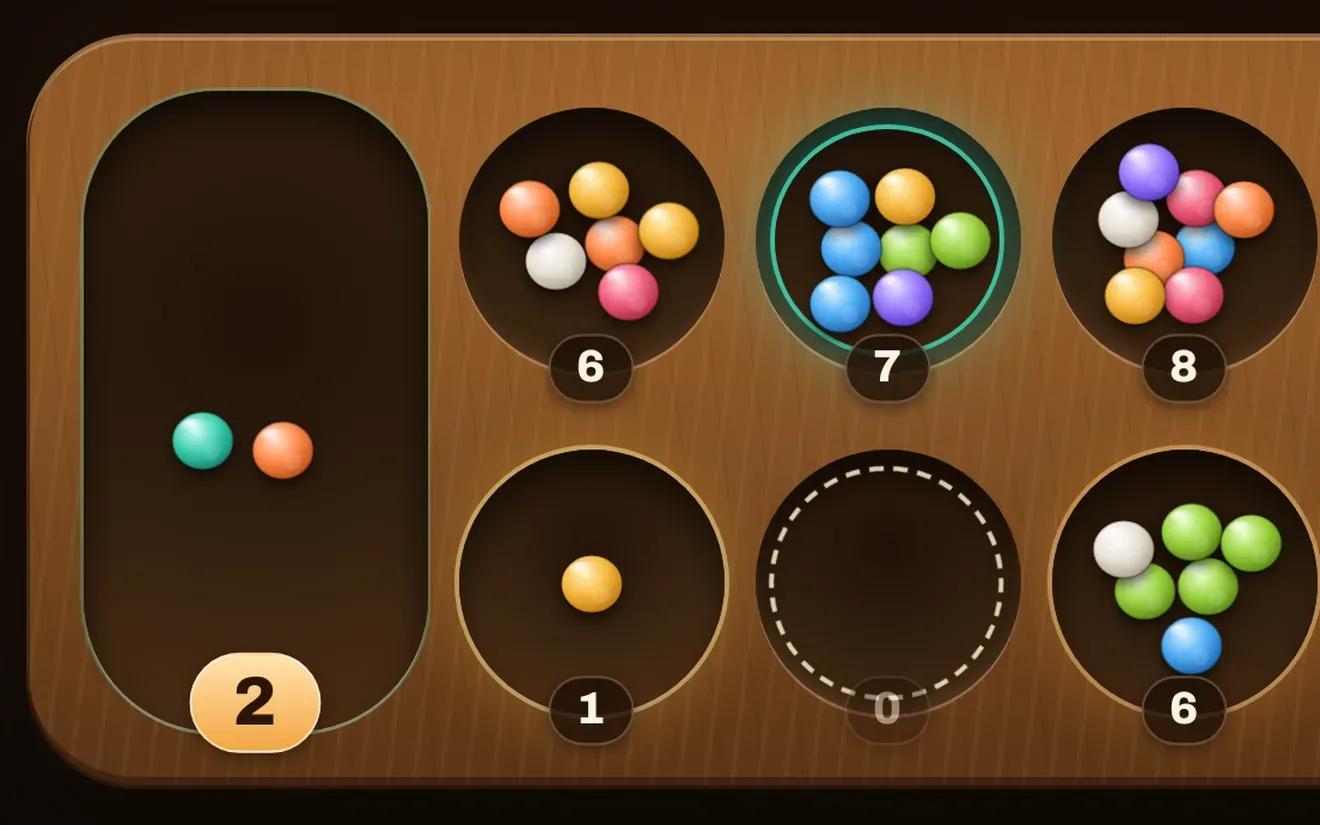
Mancala is not one game but a large family of "sowing" games, played with seeds, shells or stones in rows of little pits. In all of them you lift the stones out of one pit and drop them one at a time into the pits that follow. The version on this page is Kalah, the one most people mean when they say mancala: two players, six pits each, and a large store at each end of the board.
Playing mancala on AllFun
AllFun Mancala plays Kalah with 4, 5 or 6 stones in each pit. Against the computer, choose Easy, Medium, Hard or Master; the deepest level looks up to eleven moves ahead. 2 Players lets two people share one phone, tablet or computer, and the next game starts with the other player.
Play Online finds you an opponent, and Play with a friend makes an invite link or a room code. Online, each move has 30 seconds. Before you let go of a pit, the board shows where its last stone will land, rings a capture in turquoise and lights your store in gold when you will move again.
The rules
Setting up
The board has two rows of six pits. The row nearest you is yours, and so is the big store to your right; the other row and the store on your left belong to your opponent. Every pit starts with the same number of stones, usually four, and both stores start empty. The players take turns.
Sowing
- On your turn, pick one of your own pits that has stones in it and take them all out.
- Moving counter-clockwise, drop one stone in each following pit: along your row, into your store, then along your opponent's row.
- Skip your opponent's store. With enough stones you go all the way round, back into your own pits.
Another turn
If the last stone you drop lands in your store, you take another turn straight away. Several free turns in a row are possible.
Captures
If the last stone lands in an empty pit on your side, and the pit directly across from it has stones, you capture: those stones and your last stone all go into your store.
The end and the score
The game ends as soon as all six pits on either side are empty. Each player then moves any stones still in their own pits into their own store. Count the stores: the player with more stones wins, and equal stores are a draw. With four stones a pit there are 48 in play, so 25 is always enough to win.
Six tips for mancala
- Count the distance. The pit next to your store gives a free turn with one stone, the one before it with two, and so on.
- Take free turns from the right first. That often leaves another pit lined up for a second one.
- Set up captures. An empty pit of yours facing a full pit of theirs is a threat waiting for the right move.
- Guard your big piles. If a crowded pit of yours faces one of their empty pits, move it or fill that empty pit before they reach it.
- Hoard late in the game. Stones left in your pits at the end are yours.
- Think about their reply. Before you sow, check which captures and free turns your move hands to the other player.
A short history
Sowing games are among the oldest board games still played, with boards cut into rock and wood across Africa and Asia and many local rule sets. Kalah, the two-row game with stores, became a popular boxed game in the twentieth century.
Mancala FAQ
What happens if my last stone lands in my store?
You get another turn at once, and again each time a move ends in your store.
Do the stones go into my opponent's store?
No. When you sow, you skip your opponent's store and only drop stones into your own store and the twelve pits.
Who gets the stones left at the end?
When one side runs out of stones, the other player puts every stone still in their own pits into their store, and then the stores are counted.
Can I play mancala with a friend online?
Yes. Choose Play with a friend, send the link or the room code, and you meet at the same board from two phones or computers.
Ready for a game? AllFun Mancala is free and opens right here in your browser.
Play Mancala