What the game is
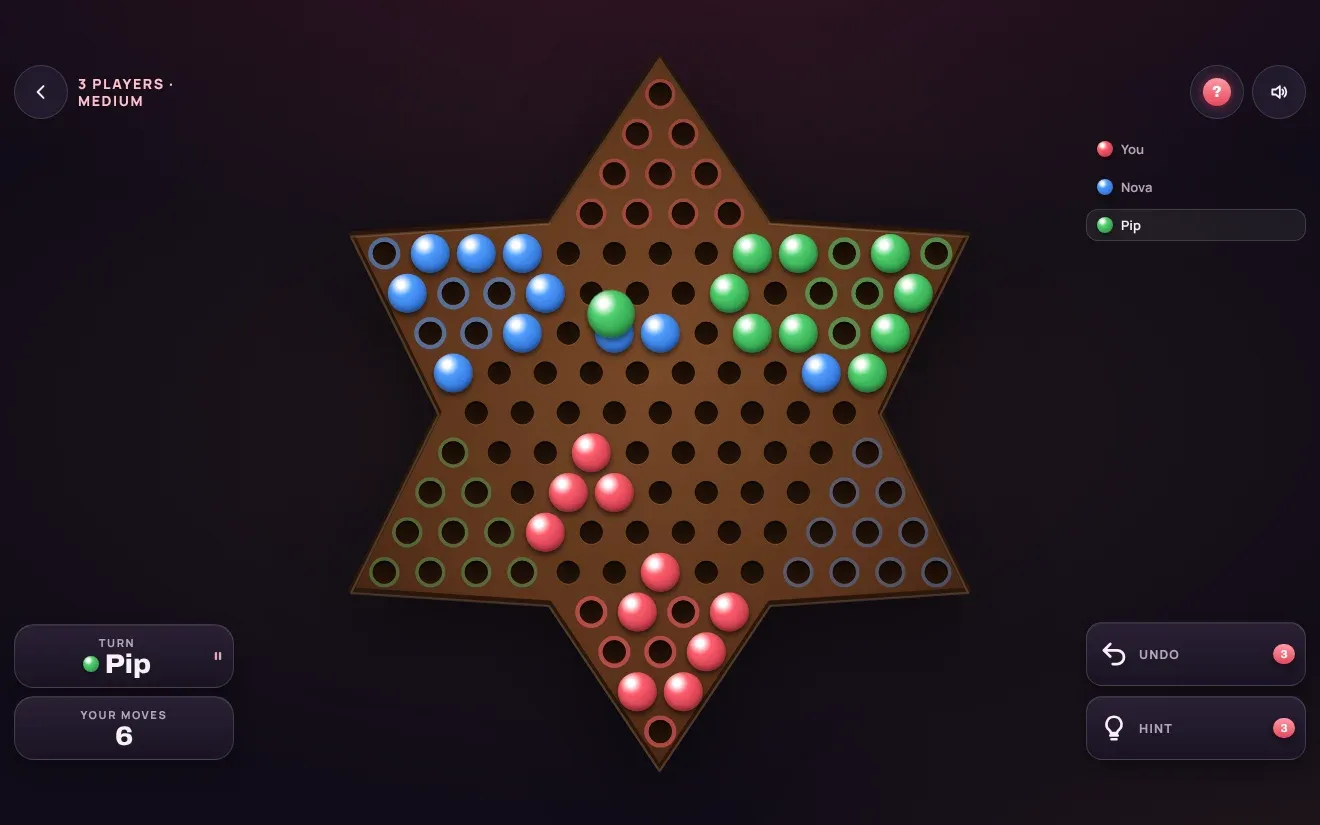
The board is a star with six points and 121 holes. Every player starts with ten marbles filling one point and races to fill the point straight across. Nothing is ever captured; you win by being faster, and the marbles of other players are as useful to you as your own, because you can jump over all of them.
Playing on AllFun
AllFun Chinese Checkers lets you choose a table of two, three, four or six, with the computer players set to Easy, Medium or Hard, or play a friend on the same device. You always have the red marbles at the bottom of the star.
Tap a marble and every hole it can reach lights up, including the far end of a long chain of jumps. Tap the hole and the marble hops there, one jump at a time. Undo and Hint are there when you need them.
The rules
- On your turn, move one marble.
- A step moves it into an empty neighbouring hole, in any of six directions.
- A jump moves it over one neighbouring marble, of any colour, into the empty hole directly behind.
- After a jump you may keep jumping, changing direction as you like, but you cannot mix a step into the chain.
- The first player with all ten marbles in the opposite point wins. A marble an opponent never moved out of that point does not stop you.
How a game unfolds
1. The opening
The first few moves bring marbles out from the front of your point. Steps are fine here; the aim is to set up jumps for later, not to rush one marble far ahead.
2. The middle
The middle of the board is where most jumps happen. Look at every marble on the board, not only yours, and ask where a chain of hops could carry you. The longest jump is not always best if it leaves a marble alone and stuck.
3. The finish
Filling the last holes of the target point takes care. Bring marbles into the deepest holes first so the ones arriving later have room, and keep the final marble close enough to reach in one or two moves.
Tips that win the race
- Build ladders. Marbles placed every other hole in a line let the marbles behind them hop all the way up.
- Leave no stragglers. A marble left behind at home will cost you several slow moves at the end.
- Borrow other marbles. An opponent's marble in the middle is a free stepping stone.
- Move the back marble. When in doubt, advance the marble furthest from the goal.
- Watch the chains. Before moving, check whether your move opens a long jump for the next player.
A short history
Despite its name, the game is not ancient and was not brought from the East. It grew out of Halma, a jumping race on a square board invented in the 1880s; a version on a six-pointed star appeared in the 1890s, and the name we know today was a sales idea of the late 1920s. It has been a family favourite ever since.
Chinese Checkers FAQ
Can I jump over my own marbles?
Yes. Any marble can be jumped, yours or another player's, and none is ever removed.
How many players can play?
Two, three, four or six. With two or four, players start in opposite points; with three, every other point is used.
How long does a game take?
About ten minutes for two players and a little longer at a full table of six.
Ready for a game? AllFun Chinese Checkers is free and opens right here in your browser.
Play Chinese Checkers